Death Valley

If you've ever wondered how a slice of toast might feel like just prior to being served for breakfast, then you're sure to find out when cycling through this dry, arid and scorching, yet highly interesting valley. In summer, the daily temps rise to well over the 100° mark, so proper planning is an absolute lifesaving necessity. Cycling down the steep 7 to 10% grades into this valley is one thing, however cycling back up out of this furnace is another thing!
The bike should be in order, have plenty of small gears and your overall condition and fitness should likewise be in best order. You can overnight at the campground in "Furnace Creek", enjoying the fantastic cool on site pool to battle the big afternoon heat having cycled into the valley during the cooler morning hours afore. The exhausting 7 to 9 hour climb out should start long before the sun arises, this bringing the daily laming heat with it.
Although, extremely hard to cycle through, it is indeed an experience you will certainly not forget so quickly.

On our CD, USA-2, you'll find all the needed info in regard to planning and undertaking this adventurous challenge.

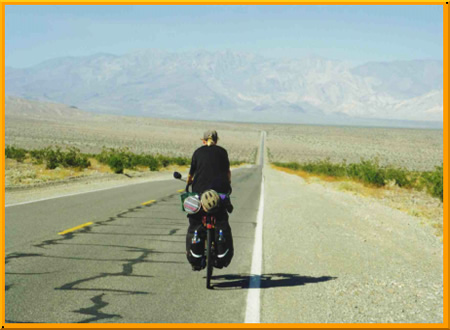
Here you don't sweat, your skin just turns salty white after several minutes in this glowing heat! What actually seems to be relatively flat in this photo is infact the long start of the at times very steep, demanding  climb back out of this roasting valley.
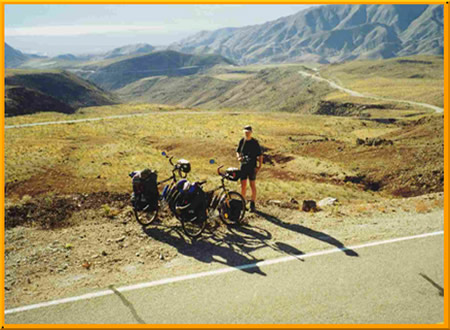
The big heat starts to pile on as you make your way down into the valley, like here at Zabriskies Pt.
The long, hard exhausting climb back out takes several hours and is best attempted during the cooler morning hours
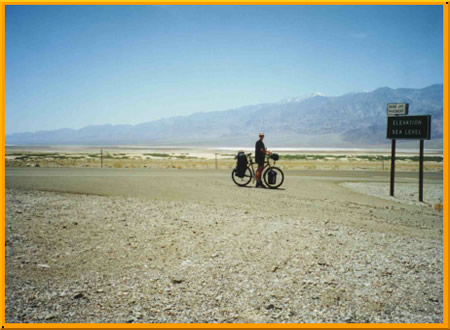
Standing just in front of the vast salt pans. As you can quite probably imagine, there is not a great deal of anything more down here than salt and sand! Note again the sandy salt pans down in the far distance to get in comparison to the photo next to this one a good idea of what you're going to cycle up out of !!!
Down in Death Valley at -282 ft, the lowest and hottest point in the whole of the USA.
Eventually, reaching the pass summit and leaving this valley, the cooler regions of the snow covered Sierra Nevada lie ahead.
Return
Home